
In a valley where the evening wind likes to linger between houses, there was a school—just like any other: hallways, lockers, backpacks, whispers, laughter, and that feeling that sometimes your whole world is decided in ten seconds between one break and the next.
Max was thirteen. He wasn’t a “nerd” or a “cool guy.” He was just a boy with a quiet stubbornness—something adults sometimes notice only after it has already saved something.
That autumn, a new gadget started showing up among the boys. Small, smooth, always somewhere in a palm or a pocket. If you had it, you were interesting for a moment. If you didn’t, you were “behind” for a moment.
It didn’t matter what it really was. What mattered was what it meant: a sign you belonged. A ticket in.
And Leo was the one who carried that ticket the loudest.
Leo was Max’s best friend. They were that familiar combination: one calm and thoughtful, the other sparkly and restless—but together they could catch the same laugh. Even when Leo was hard and sharp, Max knew it was often just armor.
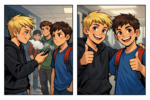
That day Leo stood a little sideways by the lockers, as if his body felt too tight. Others were around—close enough to see, far enough to pretend they “weren’t interested.” Leo lifted the device, took a pull, and let a soft mist slip out of his mouth—quickly, like a trick.
Someone said, “Give me another.”
Someone else: “Look at that.”
A third person looked at Max like a test was about to begin.
Leo pushed the device toward Max with a smile that was too wide to be real.
“Come on,” he said. “Just once. Let me see if you’re even… one of us.”
Max felt something spread through him that wasn’t fear of the device. It was fear of what happens when you say “no” in the moment everyone expects you to say “yes.”
The easiest thing would have been one small gesture—and then to forget. That’s how things begin that nobody plans.
But Max carried something else inside. Not speeches, not sermons, not “I’m better.” Just a quiet decision, like somewhere deep down he had already signed a contract with himself.
He remembered something his dad had said one evening while they were cleaning the garage. It wasn’t said like a lecture, more like an aside: “The biggest battles are the ones you can’t see. The ones in your head.”
And Max said, calmly, without raising his voice: “No.”
Just that.
Sometimes “no” is like a stone dropped into water. It isn’t loud—but the ripples travel far.
Leo froze for a moment. Then a spark flashed in his eyes.
“What do you mean, no?” he snapped. “What are you doing? It’s nothing.”
Max looked at the device and then at Leo. “I don’t need it. I’m not doing it.”
Leo laughed, but the laugh didn’t reach his heart. “Oh, so now you’re… like, pure?”
Max had a long answer on his tongue. He could list reasons. He could scare them. He could “win.”
But he had another rule inside him: truth without humiliation.
So he only said, “I don’t do this. You can… do whatever you want.”
Leo pressed his lips together. And then something happened Max had seen before: when Leo didn’t get the attention he was chasing, he tried to get it even harder.
He took another pull. The mist was bigger. The joke louder.
Max felt anger rise in his chest—not because he was jealous, but because Leo was his friend.
And Max knew that friends sometimes hurt each other exactly where they’re softest.
When Max came home, he didn’t talk right away. Sometimes it’s hard to get the exact thing that hurts out of your mouth.
He sat at the table. Dad noticed and didn’t push. Mom brought tea and set it in front of Max as if to say, You’re safe here.
Max said, “Leo… has changed.”
A sentence that means much more than it says.
Dad just nodded. “What’s going on?”
Max described the mist, the device, the others’ looks, that moment of “give me another,” “you too.”
Mom asked quietly, “And you?”
Max looked up. “I said no.”
No triumph in his voice. Just a fact.
Dad exhaled slowly, as if something tight in him had loosened. “Good,” he said. “That’s harder than people think.”
Max shrugged like he didn’t care, but inside him was that quiet fear: what will this do to the friendship?
“We’re fighting now,” he admitted. “He says I’m annoying. That I’m judging him.”
Mom sat down. “Are you judging him?”
Max shook his head. “No. I just… don’t want to.”
Dad was silent for a moment, then said, “Do you know that old story… about a boy taken far away, among strangers?”
Max looked at him. Dad wasn’t speaking like a teacher—more like he was searching for the right words.
“He was young,” Dad continued. “Everyone around him ate, drank, did things because it was ‘normal.’ But in his heart he said: I won’t. Not because he thought he was better. But because he knew who he belonged to.”
Something clicked inside Max. The story was familiar, but it wasn’t being told like a religious lesson. It was being told like life wisdom.
Dad added, “And you know what’s most interesting? That boy didn’t become everyone’s enemy. He just held his line. Calmly.”
Max said softly, “Yeah… that.”
Mom laid her hand on the table. “Max, sometimes you help most by staying steady. Not by dragging others through mud, but by staying on dry ground. Then they still have a chance to climb out.”
Max wrapped his fingers around the mug. The steam rose—warm, real. Not that mist that was part of a performance.
“Leo has it hard at home,” Max said, almost like he was apologizing for his friend.
Dad nodded. “Sometimes people make smoke so they don’t have to show they’re crying.”
Max felt a lump in his throat. “What should I do? If I talk to him, it gets worse. If I ignore him, he does even more.”
Dad said, “Two things. First: a boundary. Second: a heart.”
Max looked up. “What does that mean?”
“A boundary,” Dad said, “means you clearly say: I don’t do this. And if it turns into a show, you step away. No drama. Like closing a door because you don’t want smoke in the room.”
“And a heart?”
“A heart means you don’t close the friendship too,” Dad said. “You show him he’s still worth something even if he’s doing stupid things. But you don’t go with him into the stupid things.”
Mom added softly, “And when it’s hard, remember: you’re not alone. Even if it feels like you’re the only one saying ‘no.’”
Max nodded. Inside him was something more than “being right.” It was a calm certainty.
The next day it happened again in the hallway. Leo, the device, the mist. This time the circle around him was bigger, because last time he had gotten a reaction.
When Leo saw Max, there was a challenge in his eyes: Today I’ll break you.
Max stepped closer—not toward the device, but toward Leo.
“Leo,” he said. “Can I talk to you for a minute?”
Leo rolled his eyes, but he followed Max a little aside—just far enough that there was no audience.
Max said calmly, “I’m not doing this. That’s my boundary.”
Leo clenched his jaw. “Right. So I’m pathetic.”
Max shook his head. “No. You’re my friend. But this—this isn’t me.”
Leo wanted to answer sharply, but something got stuck, like he had to decide whether to strike or admit it hurt.
“You don’t understand,” he muttered.
Max didn’t say “I understand,” because he didn’t understand everything. He only said, “Maybe I don’t. But I don’t want us to fight because of this.”
Leo scoffed, like that hit him. “Then do what everyone does.”
Max slowly shook his head. “No. And if you pull this out just to get under my skin… I’m walking away.”
Leo raised an eyebrow. “You’ll walk away? Just like that?”
Max nodded. “Yes. Because I won’t be part of it.”
Leo fell silent. And in that silence was something new: for the first time, Max wasn’t attacking—and Leo wasn’t winning.
Leo said quietly, “Sometimes… at home it’s like I don’t know what to do with my head.”
Max only said, “I’m sorry.”
A simple sentence. But sometimes a simple sentence does more than a thousand arguments.
Then Max added, “If you want, we can go out a bit after school. Just… without that.”
Leo didn’t answer right away. Then he just shrugged. And the shrug wasn’t mocking anymore. It was a tired maybe.
Days passed. Sometimes Leo tried again. Sometimes he was angry. Sometimes he was quiet.
And Max did what he said: if it became a performance, he left. If Leo was just Leo, he stayed.
That was his path: a boundary without hate.
Max didn’t become a preacher. He didn’t become a cop. He didn’t become a judge.
He became something rarer: a friend who won’t let you pull him into the smoke—and who also won’t leave you alone when the smoke clears.
One evening Max lay in bed. Outside, the wind shifted the branches. In his head he could still hear that “just once.”
Then he remembered his dad’s story about the boy in a foreign land—how he had said in his heart, I won’t—and how that quiet decision had kept him standing.
Max closed his eyes and whispered something small, but true: “God, help me stay on the right path.”
Nothing exploded. There were no miraculous lights.
Just peace.
And in that peace Max knew: even if his “no” is small, it is strong.
Even if someone doesn’t understand him, he’s on the right path.
And even if he can’t save Leo, he can do something that is sometimes the most: stay clean and stay human.
Because some people make smoke so someone will notice them.
But Max chose to be light instead—quiet, steady, close enough not to leave a friend without hope, and far enough that the smoke wouldn’t choke him.