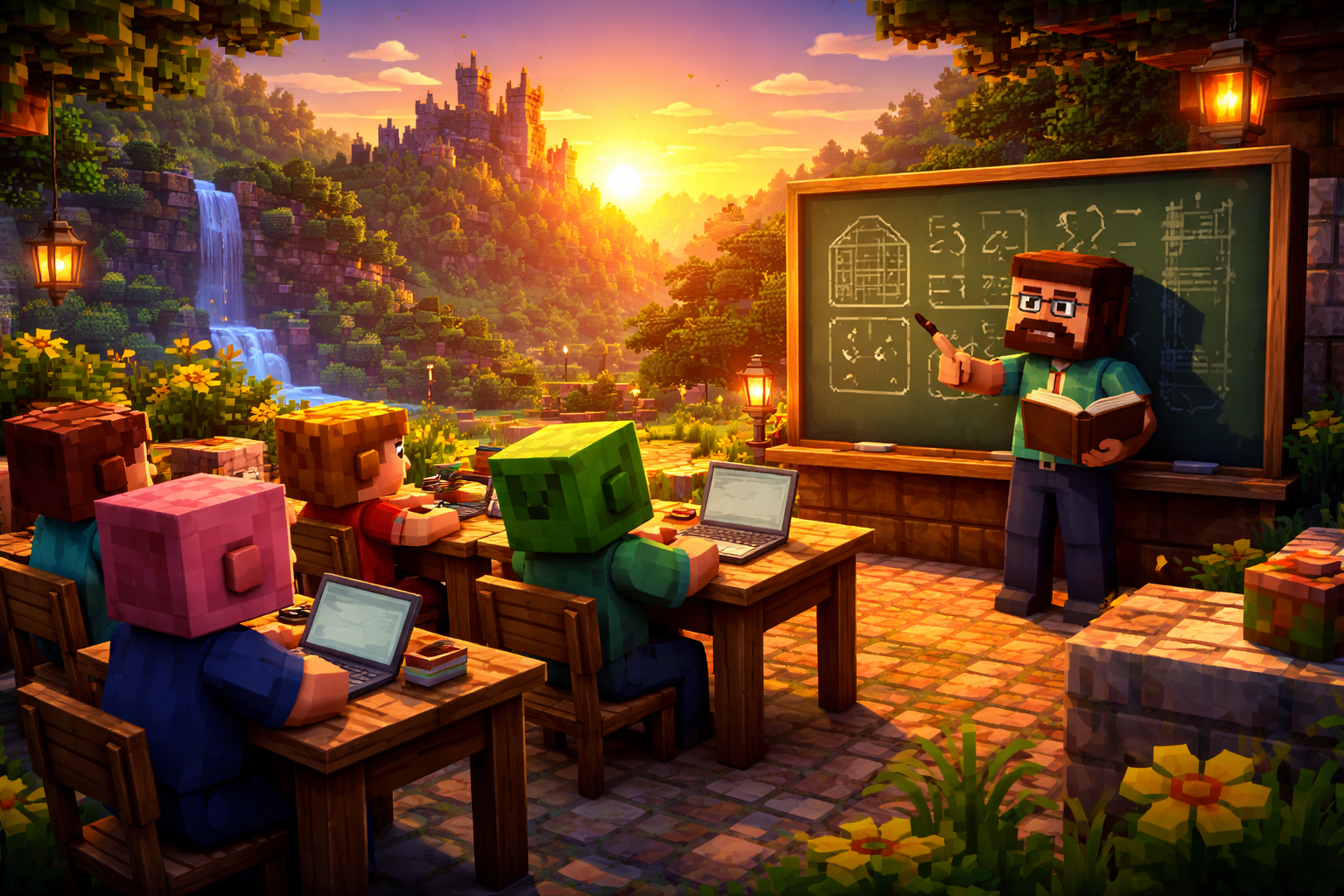
You hear it before you see it: the steady tap of keys, a small burst of laughter, a half-shouted “Nooo!” from behind a closed door. You step in, glance at the screen, and there it is again—blocks. A pixelated landscape. A character sprinting across a square hillside as if the fate of the world depends on it.
If you are a parent, you have probably had the same thought at least once: How can something that looks like digital Lego possibly matter this much?
And then the second thought, the one that arrives with a little more weight: Is this helping them… or is this just another screen?
Minecraft sits right in the middle of that modern parenting tension. It is one of the most popular games on the planet, and it is also one of the most misunderstood. The mistake we often make is treating it like a typical “video game” experience—fast, flashy, and mostly passive entertainment. Minecraft is not built like that. It is a sandbox, which means it is less like a movie and more like a workshop. The question is not whether the screen is on. The question is what your child is doing while it is on.
Minecraft Isn’t the Point—What They Do Inside It Is
Two kids can spend the same hour in Minecraft. One wanders aimlessly. The other designs a city, plans a resource economy, coordinates with teammates, and iterates on a build after feedback.
Same game. Completely different outcomes.
That is why the most useful question is rarely “How long are you playing?” It is “What are you building?” or “What problem are you solving today?”
A Workshop for Executive Function (Without the Lecture)
Watch a child play Minecraft for ten minutes and you will see miniature executive function happening in real time. They set a goal (“I’m building a base near the river”), break it into steps (“I need wood first, then stone tools, then food”), and manage constraints (“It’s getting dark, I should build a shelter before mobs spawn”).
If the plan fails—and it often does—they adapt. They rebuild. They learn to treat setbacks as part of the process rather than the end of the story.
In school, we ask children to “show their work.” In Minecraft, the work shows itself. A half-finished bridge. A farm that does not produce enough food. A house that keeps getting invaded because the lighting is wrong. The feedback is immediate, specific, and impossible to ignore.
Creativity With Constraints (The Kind That Builds Intelligence)
Minecraft is not “creative” in the sense of unlimited freedom. It is creative with constraints: limited resources, limited time, night and day cycles, hostile environments, competing priorities. This is the kind of creativity that actually builds skill.
Children learn to prototype, simplify, improve, and polish. A castle is not impressive because it is large. It is impressive because they made it with what they had, improved it over multiple attempts, and kept going when it did not work the first time.
The Quiet Math Lesson: Space, Scale, and Design
Somewhere inside those blocky structures, there is also a math lesson happening—one many children accept more willingly than anything with a textbook cover.
Minecraft constantly trains spatial reasoning: scale, proportion, symmetry, layout, navigation, orientation. Children learn what “too small” feels like when a room becomes impossible to use. They learn what “balanced” looks like when a roof line feels wrong. They practice measurement by necessity: counting blocks, mapping distances, planning walls, estimating materials.
A child who complains about geometry may happily spend an hour trying to make a circle in a square-grid world, discovering that patterns and approximations matter.
Teamwork in the Wild: Social Skills With a Purpose
When Minecraft becomes multiplayer, social learning becomes unavoidable—in the best way. Children naturally fall into roles: the builder, the miner, the farmer, the explorer, the defender, the organizer.
They negotiate. They disagree. They coordinate. They learn the difference between individual goals and team goals. They discover that communication matters—not as a school rule, but as a practical requirement. If the plan is unclear, the base ends up half built, resources go missing, and someone gets frustrated.
Sometimes, it becomes a training ground for leadership. You will hear it in simple phrases that carry adult weight: “You do food, I’ll do iron.” “Let’s meet at spawn.” “We need to finish the wall before night.”
Redstone: Engineering and Logic in Block Form
Redstone is the part of Minecraft that quietly turns it into an engineering playground. Redstone is logic: switches, circuits, timing, automation, and cause-and-effect systems.
A child who builds an automatic door is learning how systems respond to inputs. A child who builds a sorting machine is learning flow design and debugging. When they go further—command blocks, mods, data packs—the line between playing and programming becomes thin. Minecraft becomes a gateway into real technical thinking through curiosity, not pressure.
Why They Can Focus Here (and Struggle Elsewhere)
Many parents watch their children focus for long stretches in Minecraft and wonder why the same child struggles to focus for ten minutes on homework.
Minecraft is built around “flow”: clear goals, immediate feedback, autonomy, and a challenge level that scales with the player. It is a near-perfect focus engine.
The parenting opportunity is not to fight that focus. It is to redirect it.
A Parent-Friendly Shift That Works: Questions, Projects, Rituals
You do not need to become a Minecraft expert. You only need the right questions.
Try these:
- What are you building right now?
- What is the plan for today’s session?
- What problem are you trying to solve?
- Show me the coolest thing you made—teach me how it works.
- If you could improve one thing, what would it be?
If you want an easy routine, try a weekly “show-and-tell.” Ten minutes. Your child shows you their world and tells you what they built, what went wrong, and what they want to improve next. The screen becomes less of a wall and more of a window.
If you want to add structure without killing the fun, shift from time limits to projects: “Pick one goal for today.” It can be small and still meaningful—build a safe shelter, create a working farm, recreate a real building, design a bridge, build one simple Redstone machine and explain it.
The Honest Part: When Minecraft Needs Boundaries
Minecraft is not automatically educational. It can become avoidance, disrupt sleep, or introduce children to chaotic online spaces if they play on unmoderated servers.
If your child becomes consistently dysregulated when stopping, hides their online activity, or if responsibilities collapse, that is a signal to add structure and improve the environment. Often the solution is not “ban it forever.” It is “curate the context”: choose safer servers, set clearer boundaries, keep the relationship open, and make sure the digital world supports the real one rather than replacing it.
The Takeaway: A Workshop for the Future—Disguised as Play
Minecraft can be many things. It can be random entertainment. It can be a social hangout. It can be an artistic canvas. It can be an engineering lab. It can be a place where children practice planning, persistence, communication, and systems thinking inside a world that feels like theirs.
And yes, sometimes it will also be a giant chicken statue wearing a crown. Childhood is allowed to be weird.
But if you are willing to look past the blocks, you will often find something parents crave: a child engaged, making things, solving problems, and learning without being told they are learning.
That is not “just a game.” That is a workshop for the future—disguised as play.
If you would like support in turning screen time into skill time—through structured Minecraft projects, family-friendly routines, and safe digital learning environments—EduCraft.center explores practical ways to make that shift in real life.
Get in touch: https://educraft.center/contact/