
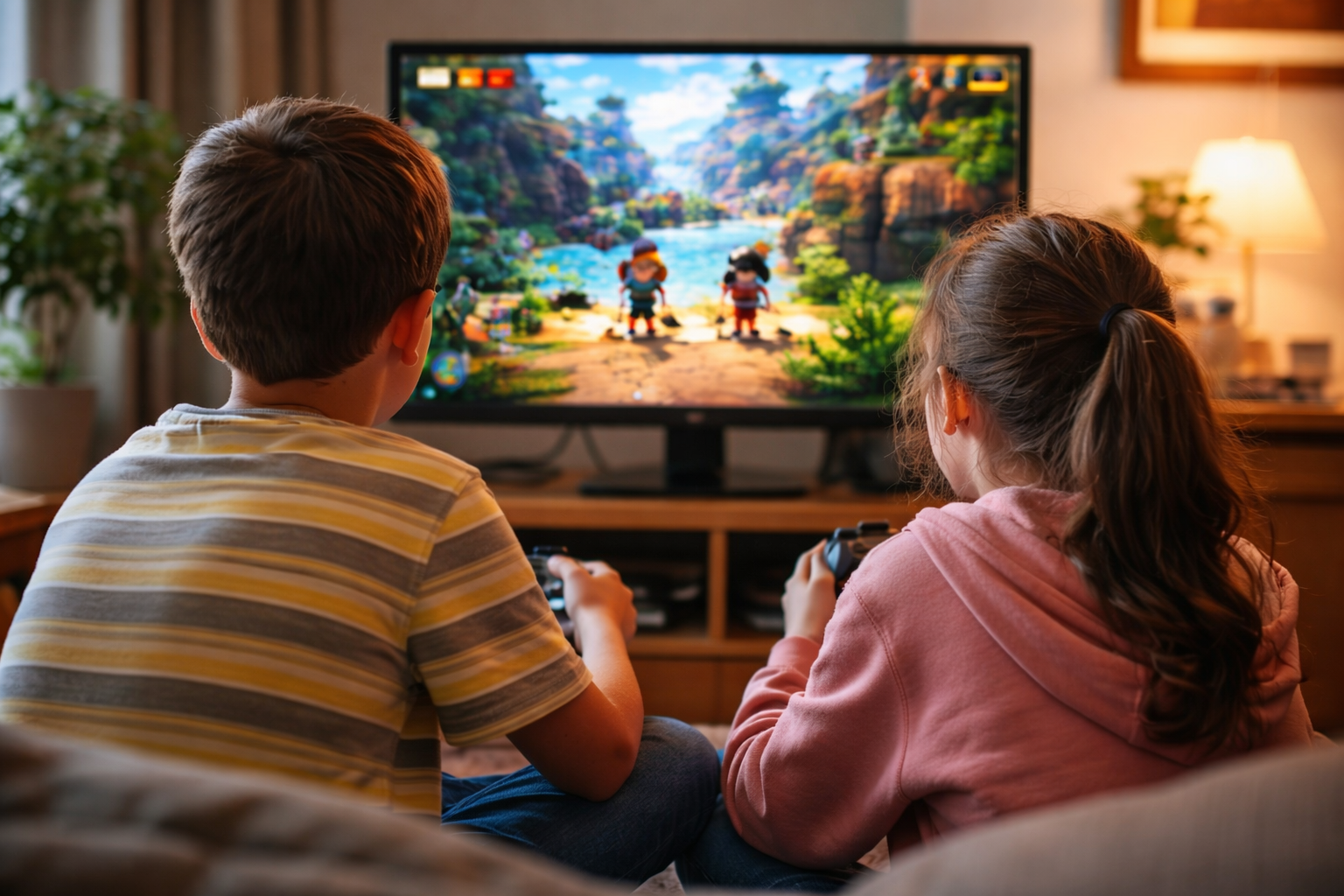
Safer screen time, privacy, and digital habits
The internet is often described as a “tool,” but in day-to-day family life it behaves more like a place.
A place where kids play, watch, learn, create, comment, react, message, join groups, follow trends, and sometimes—without even noticing—step from “fun” into “public.” Not public in the sense of a town square with a mayor and clear rules, but public in the modern sense: a space where strangers can appear, screenshots can travel, and “private” can become “shared” faster than anyone intended.
That sounds dramatic. It doesn’t need to be.
Because the most useful idea in online safety is also the least exciting: a small set of habits prevents a surprisingly large number of problems. When those habits are in place, the internet becomes more enjoyable, not less—because you’re not quietly gambling on a single unlucky moment.
This article isn’t a warning siren. It’s a practical invitation to think: If the downside is big and the safe option is easy, why risk it?
Safety first, so the fun can last
Most online trouble isn’t caused by “bad kids” or “careless parents.” It’s caused by normal humans in a fast environment.
A child clicks something that looks harmless. A message arrives that sounds friendly. A joke goes a little too far and gets saved. A photo feels funny today and feels very different next month. A stranger is rude because—well—being rude costs less when you’re a username.
That is why “online safety” is not primarily a tech problem. It’s a life-skills problem: judgment, pacing, boundaries, and a few simple rules that keep life smooth.
If you remember only one sentence, make it this:
Online is a public space with private consequences.
The most underrated tool: a relationship
Parents often approach online safety as a choice between two extremes: total freedom or total control. Real life, thankfully, offers a better option—one that works especially well over time.
The long-term goal is not to raise a child who can’t access risk. The long-term goal is to raise a child who can recognize risk and choose wisely—even when no one is watching.
That doesn’t happen through lectures delivered once a year. It happens through a relationship: small conversations that are frequent, calm, and non-judgmental.
If you want a single, practical ritual that makes a difference, try a weekly 10-minute digital check-in. Not an interrogation. Not “show me your phone.” Just a routine conversation that normalizes reflection:
- What was the most fun thing you did online this week?
- Did anything feel confusing, uncomfortable, or “off”?
- Did anyone ask you to click something, share something, or keep something secret?
That last word—secret—matters. In online safety, secrecy is often the first step toward trouble. The healthiest family rule is also the most reassuring one:
If you tell us early, you won’t be punished. We’ll solve it together.
This is not softness. It’s strategy. Kids who fear overreaction learn one skill very well: hiding. Kids who expect calm support learn a better skill: coming forward.
Guardrails without drama: the role of parental controls
There is nothing wrong with using parental controls. In fact, used well, they’re like seat belts: a simple safety measure that reduces harm when something goes wrong.
But seat belts are not driving lessons.
Controls can help with the basics—time limits, bedtime modes, purchase approvals, age-appropriate settings, privacy defaults. They can remove the “accidental” part of risk.
What they cannot do is replace judgment, social awareness, and self-regulation. And children are often remarkably inventive at working around pure technical barriers. That is why the healthiest approach is usually a blend:
- Guardrails for predictable hazards (late-night scrolling, surprise spending, unsafe default settings).
- Trust and skills for everything else (which is most of the internet).
Screen time: why 1–2 hours per day is a sensible default
Screen time debates can become emotional quickly, mostly because “screen time” is not one thing. A child can spend an hour creating something, learning something, or collaborating—and a different hour drifting through endless feeds that leave them more tired than before.
Still, families often benefit from a default boundary. For many households, 1–2 hours per day of recreational screen time on school days is a reasonable starting point. Not because the number is magical, but because it creates breathing space for sleep, movement, homework, boredom (yes, boredom), and real-world connection.
The more important question is not “How many minutes?” but:
What does screen time do to the child’s day?
If screens regularly disrupt sleep, shorten attention, increase irritability, or make transitions to offline life unusually hard, the solution is rarely a grand moral speech. It’s usually a small adjustment: earlier cut-off time, fewer notifications, clearer boundaries around bedtime, and—importantly—more predictable routines.
A simple family phrase helps:
“We don’t hate screens. We protect sleep.”
The internet has a memory
Here’s a thought experiment that makes online safety click for both adults and kids:
Imagine the internet is a room with invisible recording devices.
Not because someone is always watching you, but because content is incredibly easy to copy, save, and re-share. Screenshots exist. Re-uploads exist. Group chats exist. People forward things “just to a friend,” and suddenly it’s not a friend thing anymore.
The key point is not paranoia. The key point is realism:
Delete doesn’t always mean gone.
That is why the most practical posting rule is not “never post.” It’s:
Post as if it could travel beyond your intended audience.
This one habit—pausing for ten seconds and imagining a wider audience—prevents many future regrets.
Anonymity changes people
Offline, social behavior is held in place by thousands of small consequences: tone of voice, facial expressions, social accountability, and the simple fact that you can’t easily disappear mid-conversation.
Online, many of those consequences vanish. When people are anonymous, they can be harsher, bolder, or more manipulative—because the social cost is lower.
This explains two common experiences:
- Why strangers can be casually cruel in comments.
- Why certain people push boundaries in private messages.
The safest response is not to “win the argument.” The safest response is to exit the situation without feeding it.
Blocking, muting, and reporting are not signs of weakness. They are normal tools for keeping your space clean.
If you want a short line that children remember, give them this:
If someone pressures you to hurry, hide it, or keep it secret—pause and tell a trusted adult.
Pressure, secrecy, and urgency are the classic trio behind many online manipulations.
The non-negotiables (explained like a human, not a manual)
Most families already know the big rule: “Don’t share personal information.” The problem is that kids don’t usually share it in one dramatic confession. They share it in little pieces.
A school name here. A sports club there. A photo with a sign in the background. A casual comment about routines. Over time, small details can assemble into a full picture.
So the real skill is information hygiene: sharing less than you think you can, and being especially careful with anything that points to real-world identity or location.
The same goes for “face reveal.” This is not a moral issue. It’s a risk issue. When identity becomes easy to pin down, other risks rise with it: unwanted attention, harassment, impersonation, and content being reused without consent. For many kids, the safest approach is simple: no pressure to reveal. If it ever happens, it should be a thoughtful choice, not an impulsive moment.
Then there are links, downloads, and “free” offers. The internet is full of messages that sound helpful: free access, free perks, free gifts, free upgrades. Sometimes it’s harmless marketing. Sometimes it’s phishing. Sometimes it’s malware. Sometimes it’s account theft.
A good family rule is blunt but effective:
Never click links from strangers. Never share passwords. If you’re unsure, ask.
This is not about mistrusting the world. It’s about respecting reality.
Finally, private conversations. The internet makes it easy for people to move from public spaces into private messages. That transition is where many problems start—not because private messaging is always bad, but because it removes witnesses and raises pressure.
A calm rule that fits many families is:
Private conversations are for people we actually know and trust. If someone unknown tries to move things private, we step back.
If something goes wrong, do this first
Even with perfect habits, uncomfortable situations happen. What matters is what you do next.
The most common mistake is reacting emotionally in the moment: replying, arguing, explaining, or negotiating. That often escalates the situation.
A better sequence is simple:
- Pause. Don’t respond in panic.
- Save evidence. Screenshot usernames, messages, links—quietly and quickly.
- Block and report. Use the platform tools without guilt.
- Tell a trusted adult. Early is always easier than late.
- Secure accounts if needed. Change passwords, enable two-factor authentication, review devices.
A family that treats mistakes as learning moments—rather than shame moments—creates the strongest kind of safety: the kind that shows up early.
A small agreement that changes everything
Many parents try to manage online life through spontaneous arguments: “Get off now.” “Why are you still on?” “I told you…” It’s exhausting for everyone.
A calmer approach is a simple family agreement—short enough to remember, fair enough to follow. It can be as basic as:
- A weekday/weekend screen-time plan.
- No screens in bed (protect sleep).
- No personal details or live location sharing.
- No clicking links or downloading unknown files.
- No private conversations with unknown people.
- Spending rules for purchases.
- A promise: if something feels off, tell us—no blame.
- A weekly 10-minute check-in.
This transforms online safety from a daily fight into a shared routine.
Closing thought
This article isn’t here to scare you—and it’s not asking anyone to live in fear of the internet. It’s doing something more useful: naming risks that are real, common, and often avoidable.
For years, some of these safety conversations were treated as awkward or overprotective. Today, they’re increasingly seen as normal “digital life skills,” because the internet is not a side activity anymore—it’s a major environment where childhood happens.
The goal is not to ban the environment. The goal is to learn how to live in it well.
When we choose a few cautious habits—especially around identity, privacy, and pressure—we don’t lose the fun. We protect it. And that’s the best kind of safety: quiet, practical, and built to last.