
or years, nutrition has felt like a revolving door of “always” and “never.” One decade tells you butter is basically a villain; the next quietly moves it back into the room—without the dramatic apology tour.
More recently, mainstream guidance has increasingly emphasized a simple, practical shift: more real, nutrient-dense foods (especially protein), fewer ultra-processed calories, and a more honest conversation about fats. In that context, a meat-forward approach—including a carnivore-style trial—stops sounding like internet theater and starts looking like a hypothesis worth testing.
Not a belief system. A hypothesis.
Why meat and saturated fat are being reconsidered
“Saturated fat” became a cultural shorthand for “bad,” in part because it was easy to communicate. But nutrition rarely behaves like a single-variable equation.
Two clarifications matter:
- Food is not a nutrient in isolation. Steak is not the same as processed meat in a bun with sugar sauce and fries.
- Outcomes are not identical for everyone. Some people see markers improve, others see LDL rise. Context and individual response matter.
What has become increasingly hard to ignore is that many people feel better—not because they found a magic nutrient—but because they returned to simpler, higher-satiety foods and removed a large portion of modern, ultra-processed intake.
A small but useful “reality check” here: the human body is often cited as being up to ~60% water (it varies by age, sex, and body-fat level). Once you set water aside, what remains is largely protein and fat, plus minerals. A classic chemical analysis of an adult human body reported roughly 67.85% water, 14.39% protein, 12.51% fat, and 4.84% minerals (“ash”) by total body weight.
That does not prove an all-meat diet is “the answer,” but it does support a modest point: protein and fat are not fringe macronutrients. They are literally core structural and functional building blocks.
The evolutionary angle (said carefully, not loudly)
A popular argument goes like this:
“Humans spent most of our history as hunter-gatherers. In colder periods—especially Ice Age conditions—there simply weren’t many edible plants year-round. Our bodies likely adapted to thrive on animal foods.”
There’s a solid intuition here, with one important nuance: human diets were diverse, varying by geography, season, and technology. We were not one uniform tribe eating one uniform menu.
Still, it is reasonable to say:
- For most of human time, farming didn’t exist.
- In many climates—particularly cold and seasonal ones—plant availability would have been limited for long stretches.
- Animal foods offered dense calories and micronutrients when plants were scarce.
So the argument is not “plants are bad.” It’s: our physiology appears compatible with a high-animal-food diet, especially under constraints like cold seasons and limited vegetation.
“Are we herbivores, omnivores, or carnivores?” (the anatomy argument)
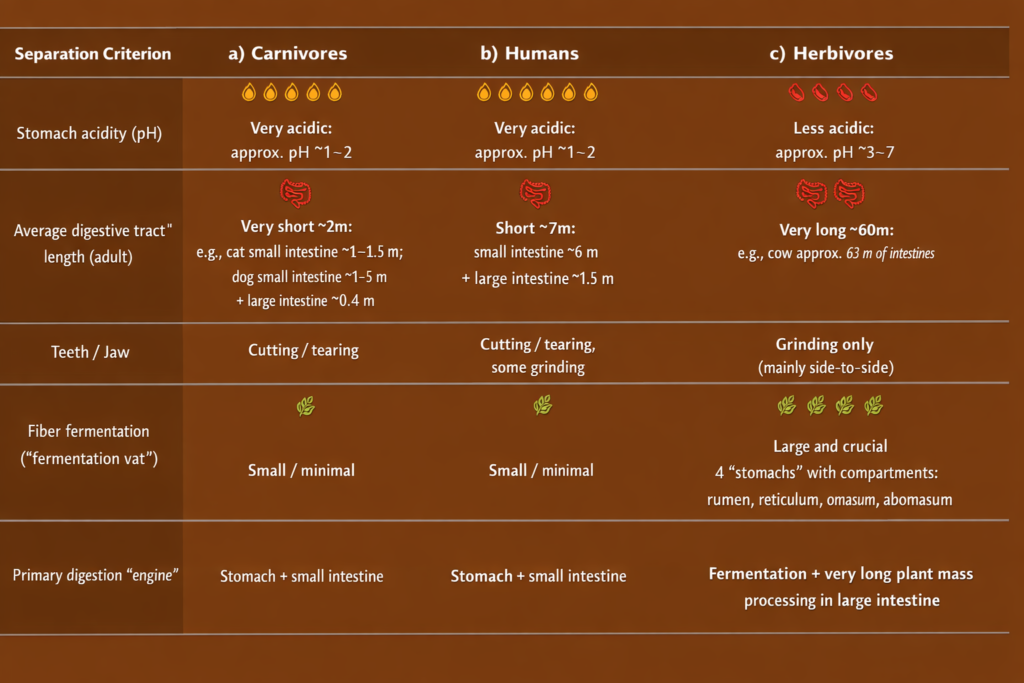
This is where a common comparison chart comes in—contrasting typical traits of herbivores, humans, and carnivores. Here is the same idea expressed in English, in a clean, readable format:
Herbivore vs. Human vs. Carnivore — Key Digestive Traits (simplified)
| Criterion | Carnivores | Humans | Herbivores |
|---|---|---|---|
| Stomach acidity (pH) | Very acidic (around pH 1–2) | Very acidic (around pH 1–2) | Less acidic (roughly pH 3–7) |
| Digestive tract length | Short | Relatively short/moderate | Very long |
| Teeth & jaw motion | Cutting/tearing | Cutting/tearing + some grinding | Mostly grinding, strong side-to-side |
| Fiber fermentation capacity | Minimal | Limited | High (often specialized fermentation chambers) |
| Primary digestion “engine” | Stomach + small intestine | Stomach + small intestine | Fermentation + long processing time |
Two subtle but relevant supporting points:
- The human gastric lumen is indeed described in peer-reviewed medical literature as having a pH around 1–2 (very acidic), which supports efficient protein digestion and microbial control.
- True herbivore specialists—especially ruminants—have large, specialized fermentation compartments where microbes break down plant fiber; cows, for example, have a four-compartment stomach and depend heavily on microbial fermentation. Humans simply don’t have that kind of fermentation “hardware” to the same degree.
What this illustrates: humans are not built like classic herbivore fermentation machines.
What it does not prove: that humans must eat only meat, or that plants are inherently harmful. It’s an argument about compatibility, not exclusivity.
Why people report benefits on carnivore (without needing miracles)
When people say a carnivore approach “works,” it often correlates with a handful of practical mechanisms:
- High satiety from protein and fat
Many people naturally eat less when meals are simple and filling. - A dramatic drop in ultra-processed foods
Removing refined carbs, added sugars, and constant snacking can change appetite dynamics quickly. - Stable blood sugar patterns for some individuals
Especially for those who react strongly to frequent carbohydrate swings. - Elimination of specific triggers (for some)
For certain people, a strict elimination phase can reveal personal sensitivities—whether those come from particular plant foods, additives, or food combinations.
This is why a meat-only phase is often framed as a “reset.” It’s less about ideology, more about signal detection: remove variables, watch what changes.
Who publicly supports meat-forward / carnivore approaches
Several physicians and prominent voices advocate for a carnivore or strongly meat-forward approach—often based on clinical experience with low-carb/keto interventions, metabolic markers, or patient-reported outcomes. Commonly cited names include:
- Shawn Baker, MD
- Ken Berry, MD
- Anthony Chaffee, MD
- Georgia Ede, MD
- Philip Ovadia, MD
- Robert Kiltz, MD
- Public figures who have popularized the discussion (not necessarily “medical endorsements”): Jordan Peterson, Mikhaila Peterson, and others
This does not settle the scientific debate. It simply explains why the topic persists beyond trend cycles: there is a visible community of clinicians and patients arguing that the approach deserves consideration.
The neutral, practical ending: an experiment you can run responsibly
A meat-only diet is a strong intervention. That can be useful—but it also demands humility.
If you are curious, the most sensible framing is:
- Try it for a short, defined period (e.g., 14–30 days),
- Track meaningful outcomes (energy, sleep, appetite, digestion, performance, cravings),
- And—especially if you have risk factors—consider baseline and follow-up labs with professional input.
Not everyone will respond well. Some people may see lipid changes they don’t like. Others may feel fantastic. Your body is not a debate forum; it is a measurement system.
And this brings us back to the “pyramid flip” moment: modern nutrition is slowly re-centering on what most people can agree on—food quality matters, protein matters, and ultra-processed calories are a major problem. Whether someone chooses a balanced whole-foods approach, low-carb, animal-based, or a strict carnivore trial, the common thread is the same:
Your diet should improve your health and daily functioning—not just win arguments.
The most useful takeaway is not “eat this” or “avoid that.” It’s that the conversation is opening up again. For a long time, certain ideas—especially around saturated fat, meat, and protein-first eating—were treated as unsayable in polite nutrition company. Now, as mainstream guidance shifts toward real food and away from ultra-processed calories, those ideas are resurfacing in a more balanced way.
If you choose to explore a meat-forward approach, do it deliberately: set a defined period, track how you feel and function, and seek professional input if you have medical risk factors. Your best diet is not the one that wins debates—it is the one you can sustain and that measurably supports your health.