
Parenting: Where Your “Calendars” Are Actually Unpredictable Events With Legs
Have you ever found yourself at 10:47 PM, scrubbing a lunchbox container with dish foam on your hands, wondering when exactly your life turned into nonstop firefighting? Welcome to the club.
The internet loves to sell us heroic-parent aesthetics: wake up at 5 AM, drink green smoothies, meditate in a spotless living room. Real life is usually closer to “hunting elephants with a flashlight.”
And here’s the important part: the problem is rarely your character. You’re not lazy. You’re not “bad at organizing.” The real issue is that you’re trying to run a complex, multi-person household on the memory of a single human brain.
1) The invisible work: why your brain feels overheated
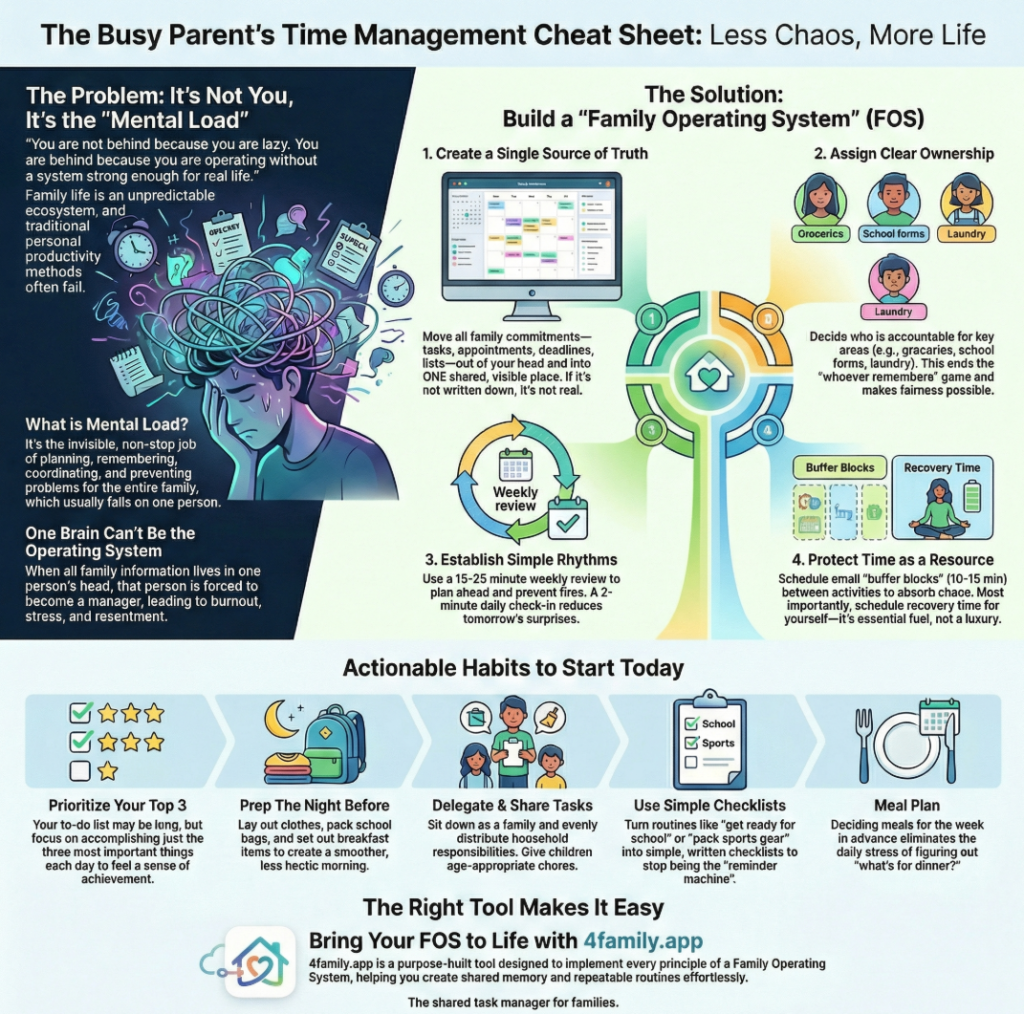
You’ve probably heard the term mental load. It’s not the physical act of doing laundry—it’s the invisible part: remembering that tomorrow is sports day, that the shoes must be white (because apparently blue violates an ancient school prophecy), that a form needs signing, and that the fridge is running low on milk.
It’s like a browser with 42 tabs open. At some point, the system starts lagging.
The big unlock is simple: externalize. Move information out of your head and into a shared, visible system. If the map of family life lives in one person’s brain, that brain never truly rests.
2) Elephant hunting vs. ant stomping
“Ants” are the tiny tasks that make us feel productive but don’t move the household forward: one more message, one more micro-fix, one more “quick thing.”
“Elephants” are the big, slightly unpleasant tasks we tend to avoid: reviewing the week, aligning logistics, prepping sports gear, deciding who owns what, setting routines.
A rule that works: pick three elephants per day. If you catch those three, the day is a win—even if the laundry is still sitting in the machine (which, by the way, happens to the best of us).
3) Kids are “living sprints”
In software, teams work in sprints: short cycles of planning, executing, and adapting. Kids are basically living sprints.
Just when you decide the week will be calm and organized, your child casually announces:
“By the way, I need a penguin costume for tomorrow.”
So you don’t need a perfect plan. You need time insulation—small buffers in your schedule.
Those ten minutes between school pickup and practice aren’t wasted time. They’re nervous-system protection, so you don’t end up yelling at 5:03 PM because someone can’t find a shoe.
4) Fairer distribution: bring a light version of RACI home
One of the biggest stress multipliers isn’t the work itself—it’s when one person becomes the “operations center” for everything.
A helpful approach is a simplified RACI-style ownership model: clear responsibility instead of constant coordination. Keep it practical and small. Pick 3–5 areas and write them down somewhere visible.
Examples:
- School: one person monitors school messages/forms; the other handles signatures and returns.
- Sports: one person owns gear readiness (shoes, kit, water bottle); the other owns transportation.
- Groceries: one person owns daily basics (milk, fruit); the other owns weekly restocking.
- Health: one person owns appointments; the other owns “what to bring” (cards, meds, notes).
When ownership is clear, 80% of the “Where is my…?” and “Did you know tomorrow is…?” questions disappear.
5) How to survive without a thousand messages
Logistics communication – “Who’s picking up?”, “Did you sign the form?”, “What time is practice?”- quietly drains family energy. If you want conversations that aren’t just task lists, you need a single source of truth.
One shared place for:
- the calendar (practice, school events, appointments),
- tasks (who does what by when),
- reminders (so you don’t live on memory),
- basic agreements (who owns what).
If it isn’t in the system, it doesn’t exist – not because you’re forgetful, but because the system is overloaded.

When analog meets digital
Paper calendars are romantic. They don’t send reminders to your partner when you’re stuck in a meeting.
If you want a shared “single source of truth” that works in real life (without Excel grids and sticky notes falling off the fridge), you need shared digital “family brain” infrastructure. One option built specifically for that is 4family.app – so everyone sees the same reality: who’s doing what, which “elephants” are handled, and where those cursed white shoes are.
The core idea isn’t the app itself. The core idea is that the system does the remembering, so people can get back to living.

Conclusion: time is capital
You can spend time arguing about who forgot the dentist appointment. Or you can invest it in routines and clarity.
Start small:
- one shared place for information,
- one 5-minute evening check-in,
- three daily priorities,
- and a bit of buffer time.
You’ve earned those ten quiet minutes with your coffee.