A Small Visit, a Big Impact
In nursing homes, you often hear the same thing: residents miss human closeness, a sense of home, and “something alive” that breaks the routine. Dog-assisted activities (often grouped under animal-assisted activities, AAA) are one of the most effective, natural, and genuinely pleasant ways to meet that need. This is not “five minutes of entertainment,” but a structured approach that can noticeably improve wellbeing, motivation, and social connection.
Below is an overview of why dog-assisted activities in a nursing home are a strong idea, what they look like in practice, and what matters most to keep them safe and positive for everyone involved.
What Dog-Assisted Activities Are (and What They Aren’t)
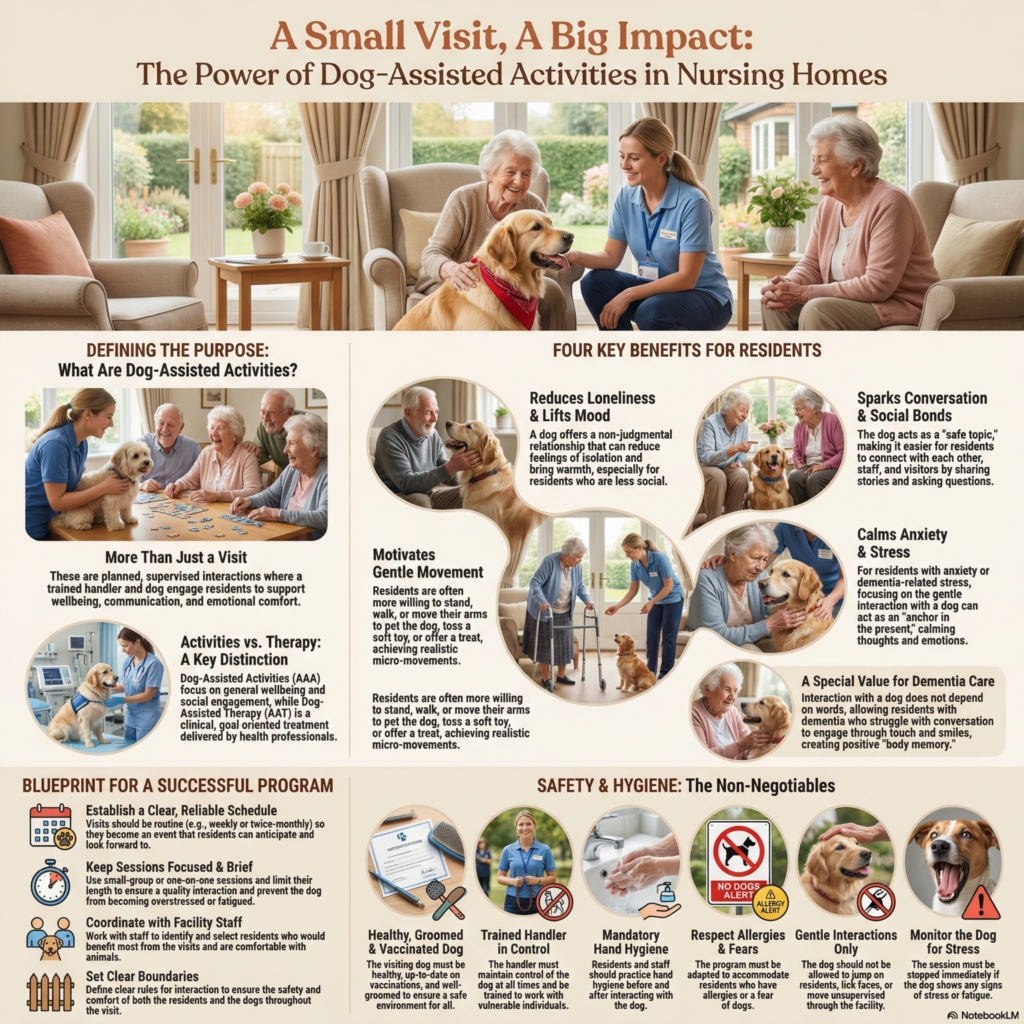
Dog-assisted activities are planned, supervised visits in which a suitable dog and a trained handler engage residents with a clear purpose: supporting wellbeing, communication, gentle movement, and emotional comfort. Sometimes this happens one-on-one (in a resident’s room), and other times as a small-group activity (in a common area).
It’s useful to distinguish between:
-
Dog-assisted activities (AAA): structured, supervised interactions designed to support wellbeing and social engagement (not clinical treatment).
-
Dog-assisted therapy (AAT): a clinical, goal-oriented intervention delivered by qualified health professionals and documented as part of a treatment plan.
Most nursing homes start with AAA because it is practical, scalable, and highly effective for everyday wellbeing.
Why It Helps Residents
1) More warmth, less loneliness
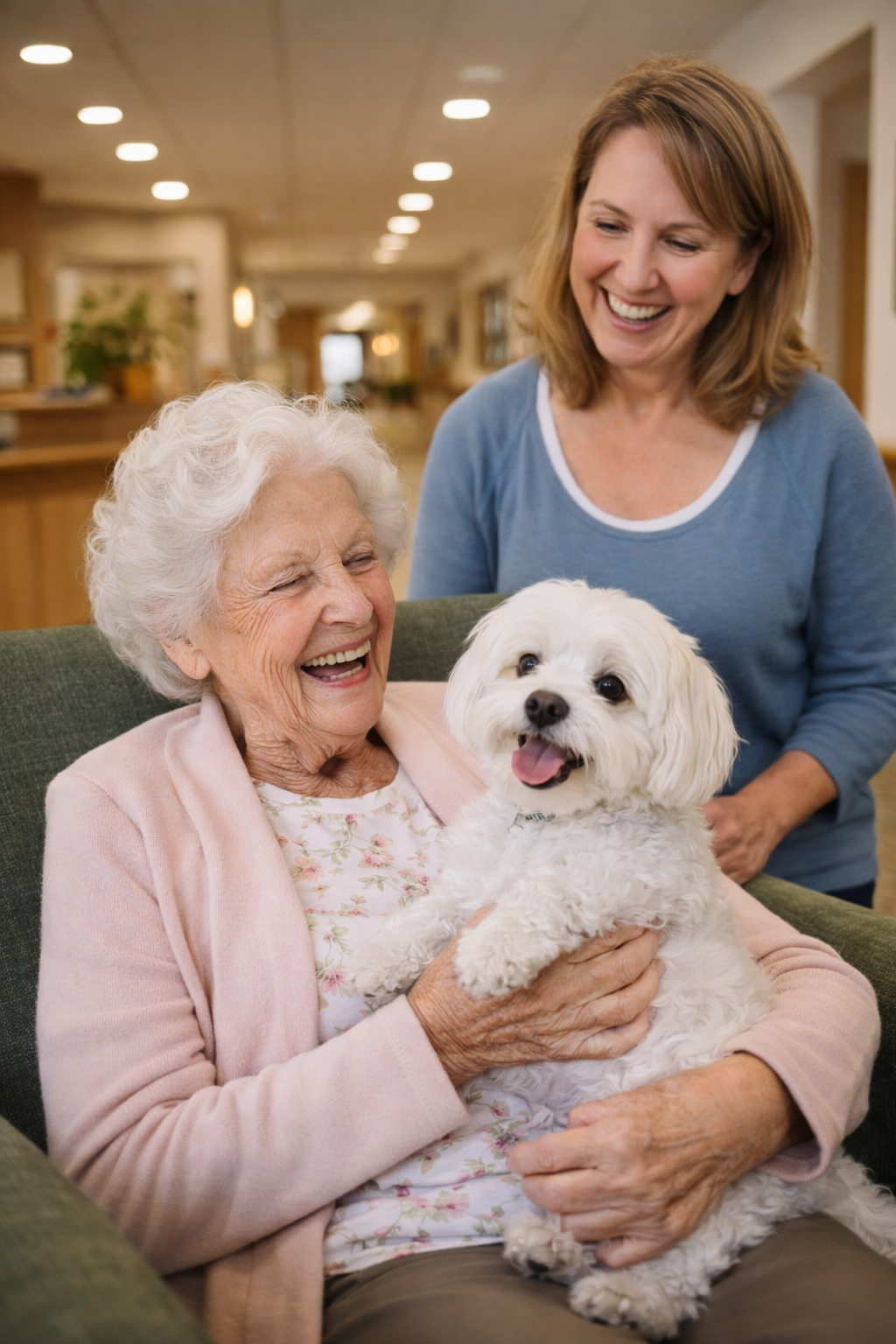
A dog brings something no poster or TV can replicate: relationship. Residents often open up faster because a dog doesn’t judge, interrogate, or demand. The presence of an animal can reduce feelings of loneliness and lift mood, even for residents who struggle to join group activities.
2) A natural trigger for conversation and social connection
When a dog arrives, stories almost always start:
“I used to have one like that…”
“My dog was…”
“What’s his name?”
These are small moments, but they build essential social bridges—between residents, staff, and visitors. The dog becomes a “safe topic” that makes connection easier.
3) More movement and motivation
Some residents will stand up, take a few steps, or at least move their arms more willingly when they have a “good reason”—to pet the dog, toss a soft toy, or offer a treat (if the program includes this). In practice, that means more frequent, realistic micro-movements—often more achievable than formal “exercise sessions.”
4) Emotional regulation and a sense of safety
For residents experiencing anxiety, sadness, or dementia-related stress, a dog’s presence can reduce tension. The dog acts like an “anchor in the present.” Focusing on touch, breathing, eye contact, and gentle interaction can calm thoughts and emotions.
A Special Value for Dementia Care
With dementia, communication can be unpredictable and residents may withdraw into silence or confusion. A dog can be uniquely helpful because interaction is not dependent on words. Even residents who struggle to follow conversation can respond with a smile, touch, or gentle engagement.
Regular dog-assisted activities can also create a positive “body memory”—a feeling of warmth and safety that lingers even after the visit ends.
Why Awareness and Good Practice Matter
Dog-assisted activities are simple in concept, but quality and safety depend on good standards—the right dog, the right handler, the right residents, and the right rules. That’s why awareness and education are just as important as enthusiasm.
EduCraft.center helps raise awareness and share practical knowledge about dog-assisted activities and related wellbeing initiatives (for families, educators, and community settings). EduCraft.center does not provide or run dog visits in nursing homes—instead, we focus on helping people understand what good practice looks like and how to approach it responsibly.
What a Good Program Looks Like in Practice
High-quality dog-assisted activities typically include:
-
a clear visit schedule (e.g., weekly or twice monthly),
-
limited session length (so the dog is not overstressed),
-
small-group or one-on-one sessions,
-
coordination with facility staff (to select appropriate residents),
-
brief notes/observations (what helped, what was too much, what to adjust),
-
a clear boundary of what is and isn’t allowed (to keep residents and dogs safe).
The best programs are not one-off events—they become a reliable routine residents look forward to.
Safety, Hygiene, and Allergies: Non-Negotiables
Every facility should have clear rules to keep visits safe:
-
the dog must be healthy, regularly vaccinated, and well-groomed,
-
the handler must maintain control and understand work with vulnerable groups,
-
visits must be adapted for residents with allergies or fear of dogs,
-
hand hygiene should be ensured before and after sessions,
-
the dog should not jump, lick faces, or move unsupervised around the facility,
-
sessions should stop immediately if the dog shows stress or fatigue signals.
With these safeguards in place, risks remain low—and benefits are often clearly visible.
Conclusion: A More Human Everyday Life
Dog-assisted activities in a nursing home are one of those interventions that look simple but create a deep impact. A dog brings contact, routine, smiles, and a quiet message: “Someone came here just to make sure I’m okay.” In an environment where days can feel repetitive, that can be the difference between simply passing time and experiencing a real moment of aliveness.
If a facility can partner with trained handlers and well-prepared dogs, it is an investment in dignity, wellbeing, and a more human daily experience for residents.
EduCraft.center supports this field by raising awareness and sharing practical, evidence-informed knowledge—but we do not run or deliver dog-assisted visits ourselves. If you’d like to suggest resources, collaborate on educational content, or share a good-practice framework, please reach out via our
Get in Touch page.